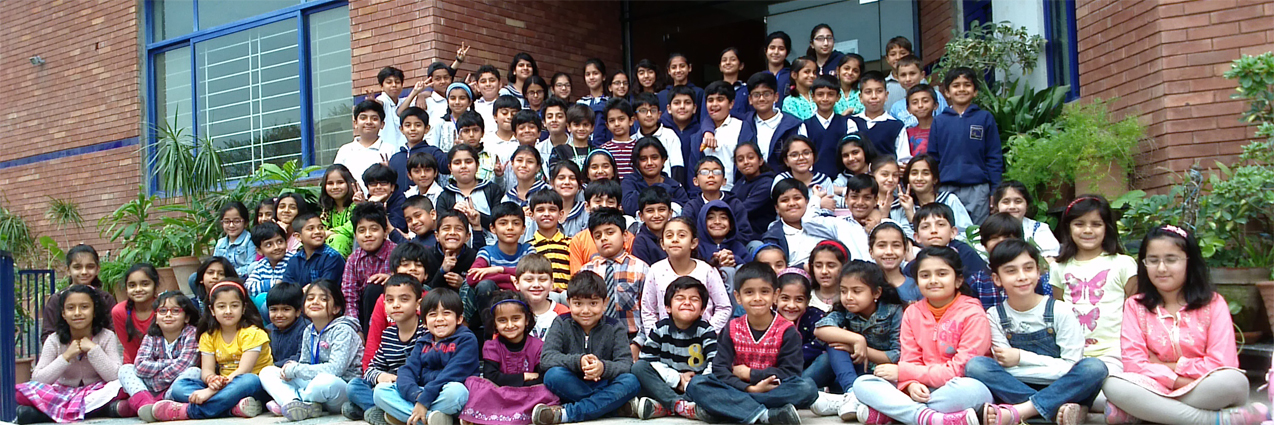
Junior School

The Elementary School Programme

During this stage of development, children learn and assimilate information rapidly, and express interest and fascination in each new discovery. These qualities make them prime candidates for education.
There are three widely accepted different areas of development for children:

• Social / Emotional Development, which involves the development of feelings and affection. Preschool-age children are beginning to develop the concept of empathy.
• Cognitive Development is the development of the mind and memory.
• Physical Development, the growth of body and strength.

Keeping these important aspects in mind, Khaldunia’s Elementary School Programme is aimed at focusing on the observation and development of a range of behaviors that occur in daily conversations, activities, and responses to learning opportunities. Children are strongly encouraged to:

• be observant & ask thoughtful questions
• develop increasingly extensive vocabularies and use increasingly complex sentence structure in discussion and elaborate on ideas
• become interested in reading
• solve problems in unique ways
• use previously learned things in new contexts and order things in logical sequence
• work independently and take initiative
• participate in art, music, or creative dramatics

A child might not show prowess in all of the above characteristics all the time, but parents and professionals will generally see a pattern when observing them over an extended period of time.

The curriculum includes Language Arts, Mathematics, Science and World Studies as core subjects, with music, art and physical education forming an integral part of the syllabus and inter-related to the children’s normal activities. The themes of environment conservation, healthy living and responsible freedom are interlinked within the entire curriculum.

At Khaldunia, we believe in creating a friendly and relaxed atmosphere in which a child can express him or herself freely. The School functions as a family in which each individual plays an important role. The children are credited with their own achievements and not adjudged in comparison to their peers – thus the criterion for assessment is normative learning.

Languages
Students are encouraged to express their own ideas and opinions. The curriculum is so structured that various confidence building strategies are incorporated into most activities. A typical day might see the children of the 1st grade make a presentation on their favourite book or describe a toy for “Show and Tell.” A 3rd grader might act out a part in a play or recite a poem for morning assembly. The 2nd graders might be playing a game of dumb charades as they learn about the parts of speech. And all students regularly use the library to borrow books both for reading development and for leisure. Poetry, fiction, factual texts etc are all grist for the mill. Children are encouraged to express their preferences. The development of analytical reasoning and logical thinking is carried out through various activities and helps the child to think critically.

Written work embraces a wide variety of themes, both fictional and expository. While guided in the sense of preceding discussion, all written work is essentially the child’s own creative endeavour.

Mathematics
Children are encouraged to develop a clear understanding of numbers and the skills required to compute mentally and in writing. Instead of meaningless numbers being used to mechanically solve artificial problems, students use real life problems to develop their sense of logic and reasoning. They may be required to extract information and express it in suitable ways including pictorial chart forms. A typical class might see students using bottles, jars and cups to calculate how many litres of water a bucket can hold. Experiments with weights may be expressed in the number of marbles that are required to balance a piece of cheese and leads on to more sophisticated understanding of SI units. Cuisenaire rods help children perfect their understanding of fractions and the four operations while shopping trips bring to vivid life the use of money.

Science
Science ProjectThe Science curriculum demands the development of investigative skills, classification, exploration and observation, the concept of fair testing, the sharpening of observation skills, interpretation of data and recording the results of experiments. With the emphasis on experiential learning, students learn about the phenomena of life through open-ended inquiry and structured activity. An insect hunt leads to the setting up of a vivarium – plants are grown from seeds using different controls to learn what exactly a plant needs to grow. A tour through Islamabad reveals how different buildings are constructed. A theme park model could demonstrate the forces harnessed to run the rides. Children might use Braille, or draw their shadows at different hours of the day, or melt chocolate or make candles or use water guns to learn about water power….

Every activity is carefully recorded in the child’s own words and relates to his own experiences during the experiment.

World Studies
This aspect of the curriculum covers the whole gamut of the Liberal Arts, including history, culture, religion, geography and the concepts of good citizenship. Here too, the individual experiences a range of concepts including role play, dramatization, audio-visual media etc. to reinforce the ideas presented. As the children develop reading skills, they are encouraged to delve deeper into the ever growing children’s resource library.

Assessment
Khaldunia believes that formal examinations are neither a necessity nor advisable at an age when anxiety over exam preparation can detract from real learning. Assessment is based on continuous feedback and practical and written tests. A detailed record of achievements lists the level of progress made and suggests steps in further learning.

The Middle School Programme

This programme focuses on intellectual and social development. Our three-pronged approach concentrates on developing the students’ study skills, emphasizing the importance of community service and the environment and stressing the value of health and social education.

In keeping with Khaldunia’s philosophy, the programme embraces yet transcends traditional school subjects; accentuating language skills, we place fundamental importance on the acquisition of both English and Urdu for effective oral and written communication.

Core subjects include languages, maths, integrated sciences, environmental and social studies, religious knowledge, the arts and information technology. The language of instruction is English although Urdu is taught with equal vigour.

As in the elementary programme, great importance is given to experiential learning, the development of a clear understanding of concepts and free expression. Students are exposed to a wide range of ideas through educational trips, guest speakers, project and research oriented work. Students studying the Middle East might prepare a presentation involving a play on the relevant themes, dress accordingly and even host a typical Arab meal.

Drama, role play and the use of multi-media brings both historical and geographical concepts to life – for instance, students have designed their own video films to depict the French Revolution or watched films on hydroponics (soil-less culture) or watched a demonstration of how the smallest bits of refuse or recyclable materials can be used to make a variety of toys which depict the use of various concepts.